Today, I speak with Will Schwalbe, who is an author and long time publishing rockstar. One of the most overlooked aspects of one’s personal branding strategy is their use of email. Email is used a lot in our communications, sometimes more than phone and in-person meetings. If you don’t brand yourself properly in every single email you write, you may not receive the answer you are looking for.
Although other forms of communicate are on the rise, such as Twitter, Facebook, AIM, Skype and more, email still seems to be the most popular. In fact, when you follow people on Twitter or add Facebook friends you get an email. Why do you think email is so important, common and what is the future of email?
Even though other forms of communication are on the rise, email remains the dominant form of business communication. There are many reasons for this, First, it’s just been around the longest — so people are used to it. But more than that, it’s still the easiest to archive and search. You can easily attach files to your emails — and download them onto your computer. You can use it to reach groups as well as for individuals, and you can reach pretty much anyone — not just people in a closed system or social network. The phone didn’t kill the letter — we still write them and send them.
Email didn’t kill the phone or the letter. And other forms of communication probably won’t kill email. But the rise of other forms of communication will help us use email for the things it’s good for — and maybe help us stay away from it when it isn’t the best choice. It’s also important to remember that email is a broad term — just as their are different kinds of written communications (letters, junk mail, memos), so too there are different kinds of electronic mail. Some forms may remain far more prevalent than others.
When should you email and when should you call, fax, or just show up?
“Whenever things are getting complicated — well, then it’s time to get off of email.”
A mathematician friend of ours told us that if 10 people are trying to decide among four different restaurants, and you accept that any one person’s opinion might influence the opinions of the others, you could have one million emails on the way to a decision. And sometimes that’s what our lives feel like — a million emails trying to decide the simplest thing.
If you see “RE: RE: RE….” in the subject line, it’s time to pick up the phone! It’s also time to get off email when things are getting emotional. If your blood is boiling, it’s almost never the write call to try to lash out in an email. And even if you are just writing an angry email it to make yourself feel better — and have no intention of actually sending the thing — don’t do it. It’s just too easy to hit that “SEND” key by accident. Other times to stay off email are when you are conveying sensitive information. You should never put anything in an email you don’t wait to see on the front page of the newspaper!
But in addition to all of that, and then some, it’s good to remember how much pleasure there is in the human voice — and in visiting other living, breathing human beings. Email is a great way to supplement human relations and to tend to them — but it’s not a replacement for them.
What is the crucial—and most often overlooked—line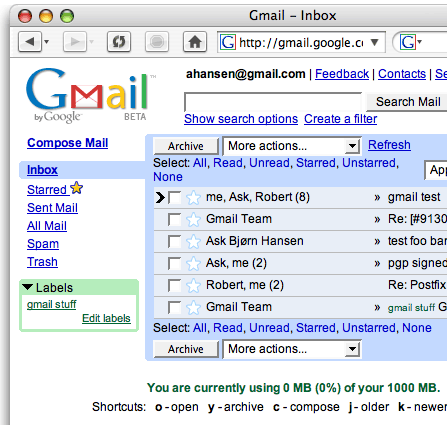 in an email?
The subject line is the most important line in an email — by a long shot. It’s the only clue you have — other than the name of the sender, if you recognize it — as to whether you want to open an email, save it for later, or delete it unread. And it’s not just the subject line — it’s the first three or four words that count. It’s important to remember that when people check their emails on a handheld they may only see the start of a subject line, not the whole thing. You need lively subject lines that describe the content — and you need to update them when the subject changes.
A subject shouldn’t refer to the initial topic that started a string — but to the current content. The Apple Mail folk, in their wisdom, actually send you a little query before you send a subject-less email asking you if you intended to do so. We think this kind of reminder should be an option on every system.
What is the best strategy when you send (in anger or error) a potentially career-ending
electronic bombshell?
When email got you into trouble it’s probably the last thing you should use to get yourself out of trouble. If you send something ghastly, in anger or in error, try, if humanly possible, to make amends in person. Pick up the phone, walk into someone office and beg forgiveness, grovel, buy a gift, write an apology letter. Because email is so easy to send, an email apology usually seems pretty lame.
It’s not a bad way to start an apology (“I feel awful about what I’ve done and am writing you this email to let you know right away how sorry I am…”), but you shouldn’t leave it at that. In the end, though, you can take comfort in this: No matter what bone-headed thing you’ve done on email, there’s a pretty good chance that the person you’ve done it to has done something similar to someone else.
What is the funniest story you’ve heard about an email mishap and what would you have done differently?
There are so many funny stories about email mishaps, it’s hard to single one out. We actually collect them on our site: www.thinkbeforeyousend.com. But we just heard of someone who emailed her best friend at work asking for advice about how to deal with a huge zit that popped up on her face hours before a hot date. Of course, she accidentally sent the email to every employee in the corporation. “Zit Girl” did get hundreds of email with useful advice and home remedies.
How can one brand themself with email? What at the marketing opportunities as you send each email?
You can do subtle branding in your emails — but you should resist the urge to turn every email into an electronic flier for your business or services. Even logos tend to un-attach. It’s very annoying to get an email with lots of attachments and then open them sequentially to discover they are simply logos and graphics. But subtle branding is different. First, the more succinct and cheerful you are in emails, the more people may want to do business with you.
And a good, tight signature block is always smart. Include your name, title, the name and address of your business, your phone, the addresses of your website and blog, if you have one. If it’s not obvious what your business is, go ahead an include a tag-line. But if your URL’s make that clear, no need. For example, Dan, your signature tells someone everything they need to know, including how best to reach you. But it doesn’t hard-sell. It’s informative, not pushy.
—–
Will Schwalbe is the former senior vice-president and editor-in-chief of Hyperion Books, and the co-author of SEND: Why People Email So Badly and How to Do It Better with David Shipley. Prior to joining Hyperion Books, he was senior vice president, editor-in-chief of William Morrow. He is on the boards of governors of Yale University Press and the Asian American Writers Workshop. Before working in publishing, he was a journalist and has written for publications including The New York Times, The South China Morning Post, Insight for Asian Investors, Ms. Magazine, and Business Traveller. He now works in new media and lives in New York.