Become a Successful Leader in All Dimensions of Life

About the author

Stewart Friedman has been on the Wharton faculty since 1984. He became the Management Department’s first Practice Professor in recognition of his work on the application of theory and research to the real challenges facing organizations. As founding director of the Wharton Leadership Program, in 1991 he initiated Wharton’s required MBA and undergraduate leadership courses. He also started and directs the Wharton Work/Life Integration Project; its mission is to develop leaders and enable change through action learning and applied research.

Stewart has consulted with a wide range of organizations and executives, including Jack Welch and Vice President Al Gore. His new book “Total Leadership” was an instant hit and today I’ll give you a sneak preview of the book.

SummaryTotal Leadership
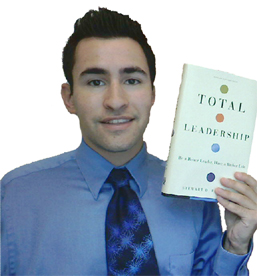
In this book, Stewart lays out his blueprint for how to become a more successful and satisfied leader in all dimensions of life, including work, home, community and self (mind, body and spirit). What you will read in this book has been proven many times in Stewart’s classes. He offers a step-by-step “four-way wins” approach to produce sustainable, meaningful change that benefits all life domains by being real, being whole and being innovative. One of the attributes of a highly successful personal brand is leadership. Although you might not feel you’re a leader in the workplace, outside of work you just might be.

Success framework

1) Being real. Acting with authenticity by clarifying what’s important: Understanding how crucial events in the past have shaped one’s values and aspirations; assessing the relative importance of work, home, community and self; taking stock of how much time and energy is invested in each of these four domains; and diagnosing one’s level of satisfaction in each.

2) Being whole. Acting with integrity by respecting the whole person: Identifying the most important people in one’s life and their performance expectations, determining how different expectations affect one another, assessing how one sues different media for connecting with these key stakeholders, and preparing and conducting dialogues with each one to verify assumptions and see things through their eyes.

3) Being innovative. Acting with creativity by experimenting with new solutions: After seeing both what and who are important in a fresh light, designing and implementing small, smart, potent experiments that swiftly produce better results in all four parts of one’s life and that transform alienation, exhaustion, and resentment into feelings of purpose, authenticity, connection, and optimism.

Picture of Dan Schawbel

Dan Schawbel

Dan Schawbel is the Managing Partner of Millennial Branding, a Gen Y research and consulting firm. He is the New York Times and Wall Street Journal bestselling author of Promote Yourself: The New Rules For Career Success (St. Martin’s Press) and the #1 international bestselling book, Me 2.0: 4 Steps to Building Your Future (Kaplan Publishing), which combined have been translated into 15 languages.

TRENDING AROUND THE WEB

A landmark study found that Catholic nuns who wrote sparse, simple autobiographies in their early twenties, when they entered the convent in the 1930s, were far more likely to develop Alzheimer’s disease roughly six decades later, with about 80 percent of the low-complexity writers eventually developing the disease compared to only 10 percent of those whose youthful essays were dense with ideas

A landmark study found that Catholic nuns who wrote sparse, simple autobiographies in their early twenties, when they entered the convent in the 1930s, were far more likely to develop Alzheimer’s disease roughly six decades later, with about 80 percent of the low-complexity writers eventually developing the disease compared to only 10 percent of those whose youthful essays were dense with ideas

Global English Editing

Researchers reported in 2026 that they could plant a specific unsolved puzzle into a person’s dreams during REM sleep, and volunteers who dreamed about that puzzle were measurably more likely to solve it after waking up than volunteers who did not

Researchers reported in 2026 that they could plant a specific unsolved puzzle into a person’s dreams during REM sleep, and volunteers who dreamed about that puzzle were measurably more likely to solve it after waking up than volunteers who did not

The Blog Herald

Jordan Peterson opens Rule 6 of “12 Rules for Life” by asking, “If you can’t even clean up your own room, who the hell are you to give advice to the world?” — arguing that the discipline to fix a small mess is the same discipline a marriage, a career, or a country eventually demands.

Jordan Peterson opens Rule 6 of “12 Rules for Life” by asking, “If you can’t even clean up your own room, who the hell are you to give advice to the world?” — arguing that the discipline to fix a small mess is the same discipline a marriage, a career, or a country eventually demands.

Global English Editing

Happier people spent more time in meaningful conversation, a recorder study found, and when a larger study checked, that link held and the case against small talk did not

Happier people spent more time in meaningful conversation, a recorder study found, and when a larger study checked, that link held and the case against small talk did not

The Vessel

A newly built AI data center in New Mexico is reportedly drawing far more water from a drought stressed region than the company’s own public estimates suggested it would, straining a community that welcomed the project mainly for its promised jobs

A newly built AI data center in New Mexico is reportedly drawing far more water from a drought stressed region than the company’s own public estimates suggested it would, straining a community that welcomed the project mainly for its promised jobs

The Blog Herald

Psychologists did not coin emotional intelligence until 1990, and Goleman’s book did not popularize it until 1995, so people raised between 1945 and 1975 grew up with no shared vocabulary for feelings, many still improvising one from watching, guessing, and going quiet when intimacy calls for words.

Psychologists did not coin emotional intelligence until 1990, and Goleman’s book did not popularize it until 1995, so people raised between 1945 and 1975 grew up with no shared vocabulary for feelings, many still improvising one from watching, guessing, and going quiet when intimacy calls for words.

Global English Editing