Have you noticed that there are a lot of “positive-thinking” people out there who can’t acknowledge negative thoughts, concepts, or situations? Wouldn’t we have to call these people naïve, at best ? Energy to create anything requires both positive and negative – just ask a battery.
If it weren’t so “not funny,” I’d almost find it humorous when called a negative person when I address areas of life that don’t seem to be working well, like education, government, the health system, the banking system, and so on. I guess for many, they think that if they simply ignore problems, they’ll magically fix themselves; or disappear altogether.
You gotta love but you gotta hate
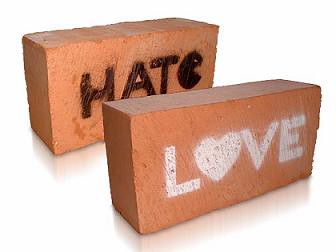 When I make this statement in my presentations, there are many in the audience who are stunned; their mouths are wide open and their expressions are that of disbelief. They never thought they would attend a motivational presentation where the presenter told them they “have to hate.”
Not only do we have to love and hate but, often times, we have to use these two words in the same sentence. “I love this country but hate what’s happening to it at this time in history.” Or, “I love Mother Earth but hate what’s she’s doing to the people in Japan with the latest earthquake and tsunami.” Or, “I love people but hate and will kill anyone who tries to harm my family.”
Personally, I think we’re intelligent and strong enough to acknowledge ‘hate’ without seeing it as a negative; but rather as a means to an end – as a way to destroy the threats to our quality of life.
Examples of the twin scenarios
▬ I love freedom but hate tyranny. We love our Founding Fathers and those who did battle to give us this great country. And we love The Greatest Generation and all our veterans who fought / fight against tyranny and oppression to maintain our way of life. And therein lies the paradox. We have to hate and kill our enemies who want to destroy our way of life. Didn’t Hitler, Stalin, and Bin Laden teach us well?
▬ I love good health and hate illness. Our blood stream is made up of red corpuscles to nourish our bodies (love) and white corpuscles to seek out and kill disease (hate). We need to love that which affords us good health (exercise, good nutrition, etc.) and hate that which threatens our vibrancy (lack of exercise, poor nutrition, etc.).
▬ I love you, my child; but hate what’s happening to you. “You will always have my unconditional love; but I hate the drugs you’re into; the people you hang around with, and the person you have become. In a loving way, let me help you change so you can achieve all that you deserve and are capable of becoming.”
▬ I love discipline, action and self responsibility; but I hate slothfulness and a sense of self entitlement. The Bible itself provides many examples and clear evidence that discipline, action and self responsibility is to be rewarded; slothfulness and a sense of self entitlement to be punished: Proverbs 10:4 “He becometh poor that dealeth with a slack hand: but the hand of the diligent maketh rich.”
▬ I love our democratic system; but hate how our elected officials are doing their jobs. There is room for spirited debate in the pursuit of serving the interests of all Americans. But there is no room for self interest and serving special interests at the expense of the interests of the America public. We must not hate our elected officials; but we can hate how they are doing their jobs.
▬ I love free enterprise and the capitalist way of life; but hate greed and corporate ravenousness. I love those who succeed and contribute to society, like Andrew Carnegie, Oprah Winfrey, and Bill Gates. I hate those who purposefully destroy the lives of others, like Bernie Madoff and those at Enron who betrayed the company and shareholders.
The enemies within
And keep in mind that love and hate are not just scenarios for the external world. Many enemies we must hate and destroy lie deep within us. Love your dreams but hate your doubts. Love your potential but hate your indifference. Love action but hate procrastination. Love forbearance but hate intolerance. Love compassion but hate insensitivity. Love yourself but hate judging yourself in ways that don’t make your life fulfilling.
One author said it best. “You cannot take the mild approach to the weeds in your garden. You’ve got to hate the weeds enough to kill them. Weeds are not something you handle; weeds are something you devastate.”
Author:
Jay Block is an industry pioneer and the nation’s leading motivational career coach. Jay is a best-selling author of 15 books, including his latest blockbuster: 101 Best Ways To Land a Job in Troubled Times (McGraw-Hill). He has a 20-year record of success for creating and recreating the career management industry. His website is: www.jayblock.com